America's turning 250, and we're celebrating the only way the YAP Dude knows how, by going deep on one of the most underrated inventions in domestic history: the clothes dryer.
What We Were Working With Before Electric Dryers
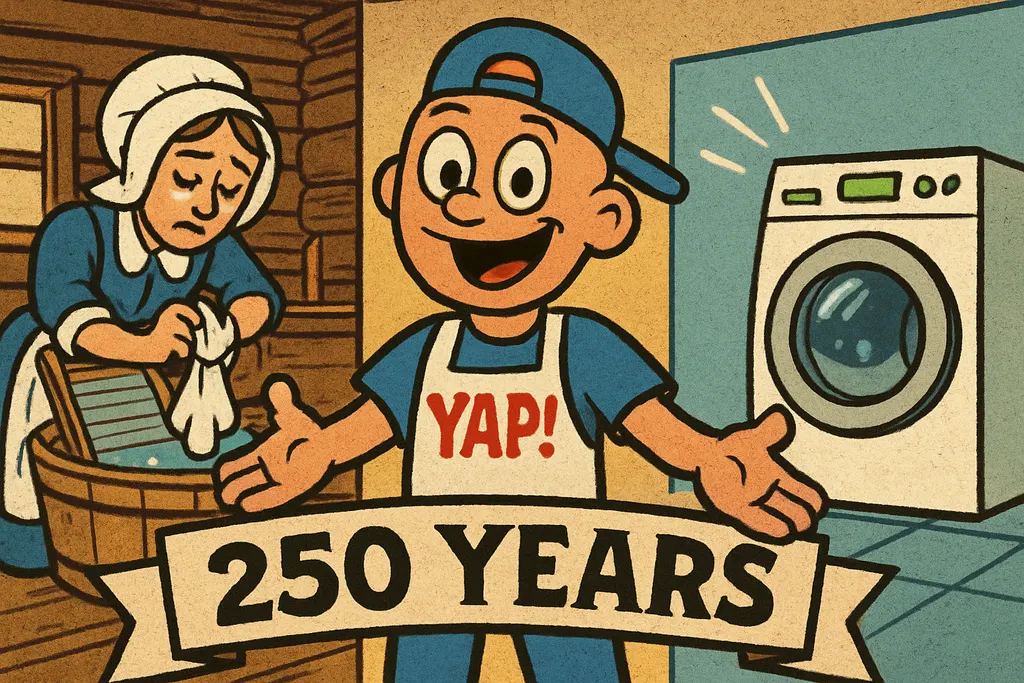
Let's go back to colonial times. You've got a homestead, a wooden washboard, a cast-iron pot of boiling water, and zero chill. Laundry day wasn't a day, it was a production. Women (almost always women, let's be honest) would spend entire days hauling water, scrubbing fabric raw, and then wrestling wet wool and linen outside to dry on fences, bushes, and eventually purpose-built clotheslines strung between posts. Rain meant you did it all over again. Winter meant stiff, frozen shirts that crackled when you pulled them off the line. It was brutal.
The clothesline era lasted a long time. Even into the early 1900s, hanging laundry was standard operating procedure for virtually every American household. Rope strung between two posts was the dryer. The sun was the heating element. The wind was the blower motor. It worked, but it worked on the weather's schedule, not yours.
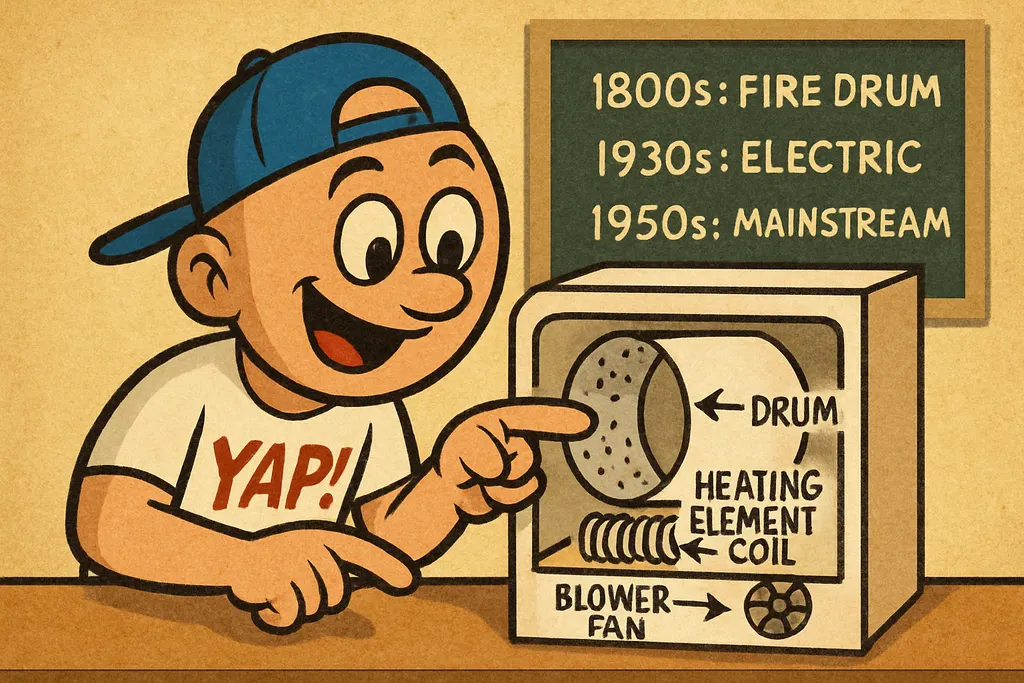
The first real attempt to mechanize drying came in the early 1800s. A Frenchman named Pochon invented a hand-cranked ventilator, basically a metal drum you'd spin over a fire. Not exactly a Maytag, but give the guy credit. The idea was right. The execution needed about 150 more years of refinement.
The Electric Dryer Invention and the Big Leap Forward
Here's where American ingenuity kicks in. By the 1930s, electric washing machines were gaining traction, and the natural next question was: can we electric-dry this thing too? Hamilton Manufacturing Company is widely credited with introducing one of the first electric clothes dryers for home use around 1937. It was boxy, it was slow, and it was expensive, but it existed. The American laundry history timeline had just hit a major checkpoint.
World War II actually slowed consumer appliance development (all the manufacturing went to the war effort, obviously), but when the postwar housing boom exploded in the late 1940s and 1950s, the dryer market blew up with it. Levittown-style suburbs, new ranch homes with dedicated utility rooms, rising middle-class incomes, suddenly a washer-dryer set wasn't a luxury, it was the American Dream made laundry-room-sized. Gas dryers entered the mainstream around this same era, giving homeowners a choice between electric and gas heat sources that we're still debating at the parts counter today.
By the 1960s and 70s, brands like Whirlpool, GE, Maytag, and Kenmore were churning out millions of units. The history of clothes dryers from that point is really a story of refinement, better thermostats, moisture sensors, larger drums, more efficient burners, and eventually the smart-home connectivity stuff we see in modern units.
The Fix (Or Rather, Why We Still Fix These Things)
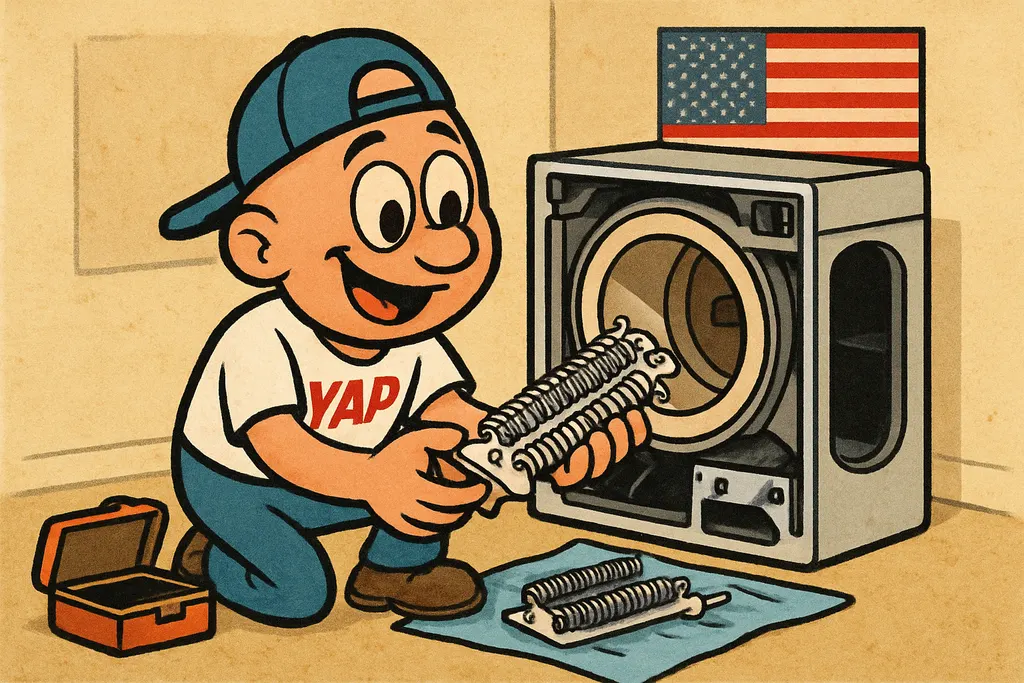
Here's the part where the YAP Dude gets patriotic in a practical way: America didn't build all this laundry infrastructure so you could throw a dryer in a landfill because the heating element gave out. These machines were engineered to last, and when a part fails, that part is what needs replacing, not the whole appliance.
Whether your dryer stopped heating, won't tumble, or is making a sound like a bag of rocks hitting a jet engine, there's almost certainly a specific part at fault:
- No heat? Usually the heating element (electric) or igniter/gas valve coils (gas), common, cheap, fixable.
- Won't start? Often a door switch or start switch, these wear out after thousands of cycles.
- Squealing or thumping? Drum support rollers, the drum belt, or the idler pulley are the usual suspects.
- Gets too hot or shuts off early? That's a thermal fuse or thermostat, critical safety components that fail and are easy to swap.
We stock parts for Whirlpool, Maytag, GE, Samsung, LG, Speed Queen, and more right here in Piedmont. Part numbers vary by model, so pull your model number off the door jamb sticker and bring it in or text it to us at 405-876-8100.
When to Call YAP vs. DIY
DIY it: If your dryer is a recognized brand and it's got a single obvious symptom, no heat, no spin, won't start, there's a very high probability it's one part. Grab your model number, call us, and we'll have you fixed same day.
Call YAP first: If you're not sure what failed, don't just start buying parts hoping one sticks. Bro, that gets expensive fast. Text us the symptoms at 405-876-8100 and we'll help you actually diagnose it before you spend a dime.
Two hundred and fifty years of American ingenuity went into the machine sitting in your laundry room. The least we can do is keep it running. Swing by the Piedmont shop or text 405-876-8100, we've got the part, we know the history, and we definitely have opinions about which era of dryers was built best. (It's the 1990s. Come fight us.)
Find your exact part.
Tell us your model number and what's broken, we'll match the OEM part, price, and availability in under 5 minutes.
Find My Part →