If you've ever stood in front of a Maytag Neptune and thought "what even IS this thing," you're not alone, this washer hit the market looking like nothing anyone had ever seen before, and there's a real story behind that.

What's Actually Going On With That Design
The Maytag Neptune washer front load design didn't happen by accident. When Maytag was gearing up to launch the Neptune line in 1997, they knew they weren't just releasing another washer, they were swinging hard at the entire premise of how Americans did laundry. The U.S. market had been riding top-loaders for decades. Front-load machines were a European thing, considered too fancy, too unfamiliar, too weird. Maytag wanted to flip that script completely, and they needed the look to match the ambition.
The industrial design work on the Neptune leaned heavily into futurism, that late-90s obsession with curves, porthole windows, and making everyday objects look like props from a sci-fi movie. Think iMac G3. Think the Chrysler PT Cruiser. Everything was trying to look like the future, and Maytag Neptune design history sits right in the middle of that cultural moment. The big circular door window, the bold horizontal lines, the way the whole front face feels more like a cockpit panel than a laundry machine, that was intentional. They wanted you to stop in the store aisle.
Maytag's in-house design team collaborated with outside consultants to nail the visual language, though the Neptune origin story on the specific designer credits isn't fully public record. What IS documented is that the machine was engineered from the ground up to be a front-loader, the look followed the function. The tumble-wash system required that horizontal drum axis, and that axis demanded a front-facing door. Once you've got a porthole, you might as well make it a feature.

Why It Stood Out So Hard From Traditional Top-Loaders
Here's the thing people forget: in 1997, walking into an appliance store meant seeing rows and rows of identical white rectangles with lift-up lids. Every Whirlpool, every GE, every Kenmore, same basic silhouette since the 1960s. The Maytag Neptune origin story is partly about design and partly about market disruption. Maytag was betting that American homeowners were finally ready to be told that the way they'd been washing clothes was just... inefficient.
And the Neptune backed it up mechanically. Front-load tumble washing uses less water, less detergent, and is gentler on fabric than the agitator-style top-loaders. The bold design wasn't just aesthetics, it was a visual promise that this machine worked differently. The look said: we're not your grandma's Maytag. (Ironically, the Maytag repairman had spent 30 years advertising exactly how reliable and boring their appliances were.)
The space-age styling also gave retailers a reason to put the Neptune front and center. It created its own gravity on a showroom floor. That's not accidental, that's smart product design serving a marketing function.
The Fix (Or in This Case: Keeping One Running)
If you've inherited or picked up a Maytag Neptune and want to keep that bold piece of appliance history alive, here's what breaks most often and what you're looking for:
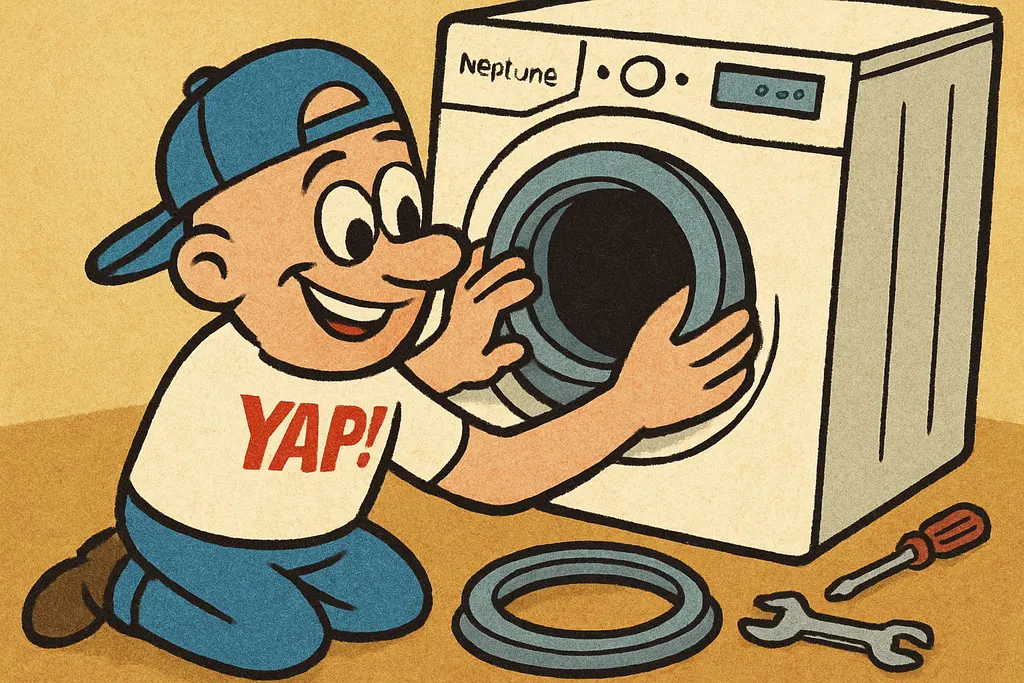
- The door boot seal, that big rubber gasket around the porthole. It cracks, molds, and leaks. This is the number-one Neptune service item.
- The door latch assembly, the mechanism that locks that dramatic front door shut during cycles.
- The front bearing and spider assembly, older Neptunes develop drum bearing noise over time.
- The control board, the brains behind that futuristic panel face.
We stock common Neptune components at the Piedmont shop. Part numbers vary by exact model year and series, so bring your model number off the door jamb sticker and we'll pull the right match.
When to Call YAP vs DIY
DIY it: Door boot seals and door latches are very manageable at home with basic tools and a good YouTube video. You can save serious money doing these yourself.
Call YAP: Drum bearing replacements and control board diagnostics are where things get complicated fast, give us a ring before you're three hours deep and questioning your life choices.
Swing by the Piedmont shop or text 405-876-8100 and we'll get you sorted. The Neptune deserves to keep running, it's too cool-looking to quit.

Find your exact part.
Tell us your model number and what's broken, we'll match the OEM part, price, and availability in under 5 minutes.
Find My Part →