You just loaded your refrigerator into the moving truck and now you're wondering if you did it right, or you're already at the new place with a warm fridge and a sinking feeling.
What's Actually Going On
Here's the deal: your refrigerator's compressor runs on oil. That oil lives at the bottom of the compressor, lubricating the moving parts so the whole system doesn't destroy itself. Under normal conditions, meaning the fridge is standing upright like God and Whirlpool intended, that oil stays exactly where it belongs.
The second you lay that refrigerator on its side (or worse, its back), that oil migrates. It creeps up into the refrigerant lines, into the compressor's cylinders, into places it has absolutely no business being. If you plug the fridge in before that oil has had a chance to drain back down where it belongs, you're running the compressor dry or with oil-logged lines. That's how you turn a working appliance into an expensive paperweight.
This is the number one reason people end up calling us at 405-876-8100 saying "my refrigerator stopped cooling after I moved." Nine times out of ten, it wasn't the move itself that killed the compressor, it was what happened after the move. The plug-it-in-immediately mistake. Don't be that person.

The Fix, or Better Yet, the Prevention
Do this right the first time and you won't be shopping for a new compressor (or a new fridge) next week.
- Keep it upright. This is the golden rule of how to transport a refrigerator. If your truck can fit it standing tall, do that. Strap it securely to the wall of the truck so it can't tip. Done.
- If you must lay it down, go side-over-back. If you absolutely have no choice but to tilt it, lay it on its side rather than its back, and try to lay it on the side opposite the hinges. Laying it on its back puts direct stress on the compressor mounting and is the worst-case scenario.
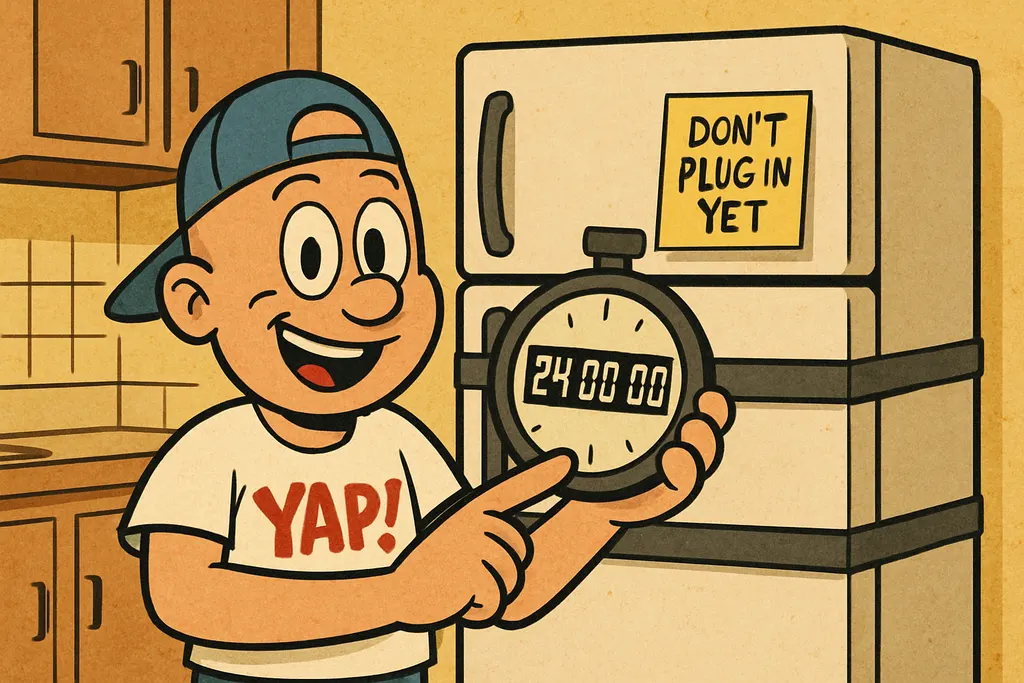
- Let the compressor oil settle before plugging in. This is the rule everyone forgets. If the fridge traveled upright the whole way, wait at least 1 hour before plugging in. If it was on its side for any amount of time, wait 24 hours. Not 20 minutes. Not "eh, probably fine." Twenty-four hours. Set a timer. Go unpack boxes. Come back tomorrow.
- Don't crank the thermostat to max right away. Once you do plug it in, let it come up to temp gradually. Give it 4 to 6 hours before you load it up with food.
- Check door seals before and after the move. Gaskets can get knocked loose or kinked during transport. A bad seal makes it look like a compressor problem when it's actually just a $15, $30 fix.
When to Call YAP vs. DIY
DIY all the way if you caught this article before the move, prevention is 100% in your hands and costs nothing but patience.
Call YAP if you're already dealing with a refrigerator not cooling after a move and it's been 24+ hours since it was upright. At that point something may have been damaged, door seal, start relay, or the compressor itself, and you'll want to know what part you actually need before you spend money guessing. We can help you diagnose it over the phone or you can swing by the shop in Piedmont and we'll look at what you've got.
If it does turn out to be the compressor, bro, we're going to have an honest conversation with you about repair vs. replace, because a compressor replacement on an older fridge sometimes isn't worth it, and we'd rather tell you that upfront than sell you a part you'll regret buying.
Swing by the Piedmont shop or call/text 405-876-8100, we're here to keep your food cold and your wallet from crying.
Find your exact part.
Tell us your model number and what's broken, we'll match the OEM part, price, and availability in under 5 minutes.
Find My Part →