You're standing in front of a broken washer, you've tracked down the part you need, and now you're staring at two options, the OEM part for $85 and an aftermarket version for $34. So which one do you actually buy?
What's Actually Going On
Let's break down what these terms even mean, because the marketing around this stuff is genuinely confusing. OEM stands for Original Equipment Manufacturer, meaning the part was made by (or to the exact spec of) the brand that built your washer. If your Whirlpool washer needs a new drain pump, an OEM drain pump comes straight from Whirlpool's supply chain. Aftermarket means a third-party company reverse-engineered the part and made their own version, usually cheaper.
Neither category is automatically good or bad. That's the real answer, and anyone who tells you different is selling something. Some aftermarket parts are legitimately solid, same materials, same tolerances, half the price. Some are garbage that'll fail in six months and leave you doing laundry at your mom's house again. The trick is knowing which is which, and that's where most DIYers get burned.
The specific part matters a lot here. For something like a door latch or a knob, aftermarket is usually fine, those parts aren't under huge stress. But for high-wear, high-stakes components like a washer's motor coupling, a drive belt, or the main control board? The OEM vs aftermarket appliance parts decision gets a lot more serious. Cheap materials in a drain pump seal, for example, can mean a slow leak that ruins your floor before you even notice.
The Fix (or Rather, The Decision)
Here's how to think through the aftermarket vs OEM quality question before you buy anything:
- Identify the part's job. Is it structural or mechanical? Does it spin, heat, seal, or control something? Higher stakes = lean OEM.
- Check the price gap. If the aftermarket part is 20% cheaper, maybe not worth the risk. If it's 60% cheaper and comes from a known supplier, worth a harder look.
- Read the reviews, but read them right. Don't just check star ratings. Look for reviews from people who've had the part for 6+ months. Early reviews mean nothing.
- Ask someone who actually knows. Seriously. Bring us the model number and the part you need, we've pulled enough of both to give you a straight answer.
- Check the warranty. Genuine appliance parts from major brands typically carry a 1-year warranty. A lot of aftermarket parts carry 90 days. That gap tells you something.
For what it's worth, at our Piedmont shop we stock both, we're not trying to upsell you on OEM just to bump our margin. Sometimes we'll hand you an aftermarket part and say "this one's legit, save your money." Sometimes we'll tell you to spend the extra $30. Depends entirely on what you're fixing.
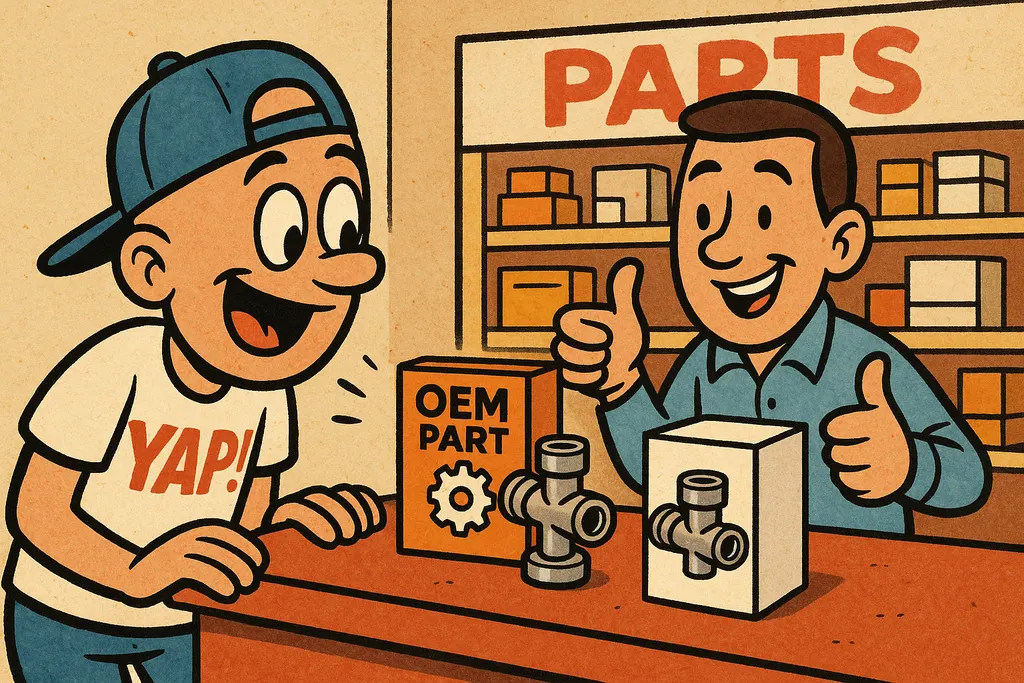
When to Call YAP vs DIY
Go aftermarket confidently when it's a low-stress part (door handles, dispenser drawers, simple gaskets) and you can find one from a reputable supplier. You'll save real money and the repair will hold just fine.
Go OEM, or call us first when you're dealing with anything electrical, anything that seals water, or any part where a failure means collateral damage to your machine or your house. This is the appliance parts comparison that actually matters: not just price, but the cost of being wrong.
Come swing by the Piedmont shop or call/text 405-876-8100, tell us your washer model and what's acting up, and we'll tell you straight up which way to go. No fluff, no upsell, just the right part.
Find your exact part.
Tell us your model number and what's broken, we'll match the OEM part, price, and availability in under 5 minutes.
Find My Part →